

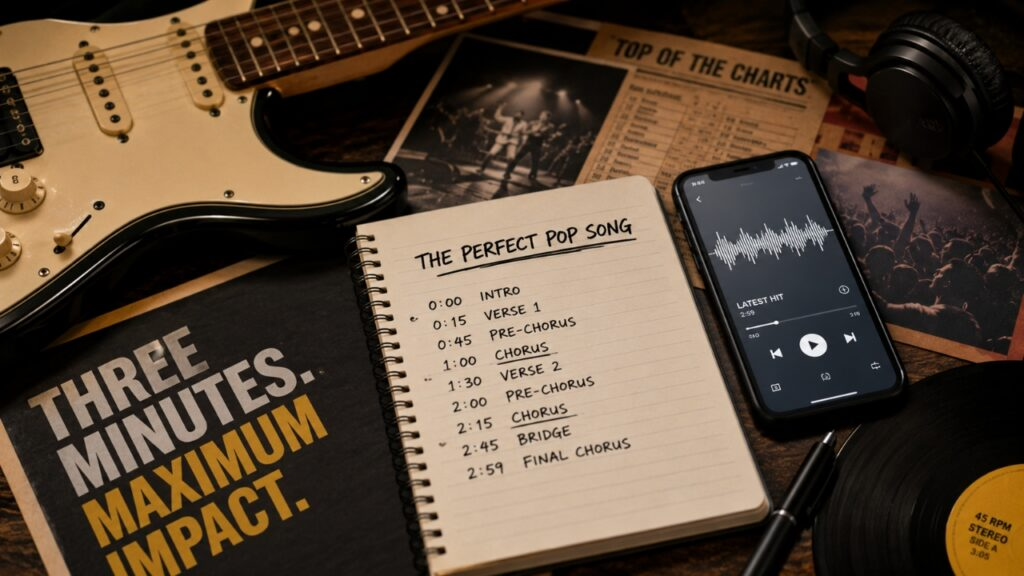
For much of modern music history, three minutes has been treated as the ideal length for a hit song. Whether it was rock, pop, R&B, or country, countless chart-topping singles seemed to end just as listeners wanted more. The pattern became so common that many people assumed it was simply an artistic choice, when in fact it was largely shaped by technology and the economics of the music business.
The story began long before streaming platforms, smartphones, or digital downloads existed. In the early 20th century, commercial records were pressed onto 10-inch shellac discs that rotated at 78 revolutions per minute. Because of their physical limitations, each side could hold only about three to five minutes of audio. Musicians, composers, and record labels gradually adapted their songwriting to fit the format, knowing that anything longer would require another disc or risk reduced sound quality.
That technical limitation continued to influence the industry even after recording technology evolved. Radio stations preferred shorter songs because they allowed more music, more advertising, and more programming within each hour. Record labels quickly realized that concise songs were also easier to promote, increasing the chances of repeated airplay. Before long, the three-minute single became the commercial standard rather than simply a technological necessity.
Many of the world’s most influential artists built their biggest hits around that formula. Songs by The Beatles, Michael Jackson, Madonna, Whitney Houston, and countless others rarely stretched far beyond the three- or four-minute mark. The structure itself became familiar to listeners, with verses, choruses, and bridges carefully arranged to deliver the strongest hook before attention began to fade.
Streaming has rewritten some of those rules, but not necessarily in the way many people expected. Today, artists no longer need to worry about the physical limitations of vinyl records or radio scheduling. Instead, they compete for attention in an environment where listeners can skip a song with a single tap. As a result, many producers now introduce the chorus much earlier, shorten instrumental sections, and reduce lengthy introductions to capture audiences within the first few seconds.
Recent chart data shows another shift taking place. Many successful pop songs are becoming even shorter than the traditional three-minute standard, with some lasting barely two minutes. Music analysts say shorter songs are more likely to be replayed, potentially generating more streams while matching modern listening habits shaped by short-form video platforms and personalized playlists.
This change has also influenced the way songs are written. Long guitar solos, extended intros, and gradual musical buildups have become less common in mainstream pop. Instead, producers often place the catchiest melody near the beginning, ensuring listeners encounter the song’s strongest moment before deciding whether to continue listening or move on to something else.
Not every genre has embraced the trend equally. Progressive rock, jazz, classical music, and many forms of electronic dance music continue to feature compositions that extend well beyond ten minutes. Even within pop, some artists deliberately release longer tracks to create a stronger emotional narrative, proving that commercial success is not determined by duration alone.
Although today’s music industry is powered by algorithms instead of vinyl records, the influence of a century-old technical limitation can still be heard in songs released every week. What began as a restriction imposed by early recording technology helped establish a format that continues to shape how artists write, producers produce, and audiences experience popular music around the world.