



By using this site, you agree to the Privacy Policy and Terms of Use.
Accept
Inframe AsiaInframe Asia
  • Asia
    AsiaShow More
  • Business
    BusinessShow More
  • Entertainment
    EntertainmentShow More
  • Lifestyle
    LifestyleShow More
    Why Some of the World’s Most Expensive Coffee Is Made From Animal Waste
    By Ayu Maharani
    Comodo Island
    The Indonesian Island Where Nobody Is Allowed to Stay After Sunset
    By Ayu Maharani
    Tonlé Sap Lake
    The Asian Lake That Disappears Almost Every Year
    By Ayu Maharani
    Why Japan Has Entire Villages With More Dolls Than People
    By Ayu Maharani
  • News
    NewsShow More
    Roy Suryo and Doctor Tifa to Face Trial in Jokowi Diploma Defamation Case
    By Fajar Nugroho
  • Science
    ScienceShow More
  • Sports
    SportsShow More
  • Tech
    TechShow More
    The Photo You Just Took Doesn’t Actually Exist
    By Andika Ramadhan
Sign In
Font ResizerAa
Inframe AsiaInframe Asia
Font ResizerAa
  • Asia
  • Business
  • Entertainment
  • Lifestyle
  • News
  • Science
  • Sports
  • Tech
  • Asia
    • Central Asia
    • East Asia
    • Middle East
    • South Asia
    • Southeast Asia
  • Business
    • Companies
    • Economy
    • Markets
    • Real Estate
    • Startups
  • Entertainment
    • Celebrities
    • Gaming
    • Movies
    • Music
    • Television
  • Lifestyle
    • Fashion
    • Food
    • Health
    • Relationships
    • Travel
  • News
    • Crime
    • Government
    • Politics
    • Society
    • World
  • Science
    • Energy
    • Environment
    • Health Science
    • Research
    • Space
  • Sports
    • Basketball
    • Esports
    • Football
    • Motorsport
    • Other Sports
  • Tech
    • AI
    • Cybersecurity
    • Gadgets
    • Internet
    • Software
Have an existing account? Sign In
Follow US

Home | Lifestyle | Why Japan Has Entire Villages With More Dolls Than People

LifestyleTravel

Why Japan Has Entire Villages With More Dolls Than People

Ayu Maharani
Ayu Maharani
Avatar photo
ByAyu Maharani
Ayu Maharani is a lifestyle writer who loves exploring topics related to everyday living, wellness, personal growth, relationships, travel, fashion, and modern lifestyle trends. She enjoys...
June 24, 2026
Share
SHARE

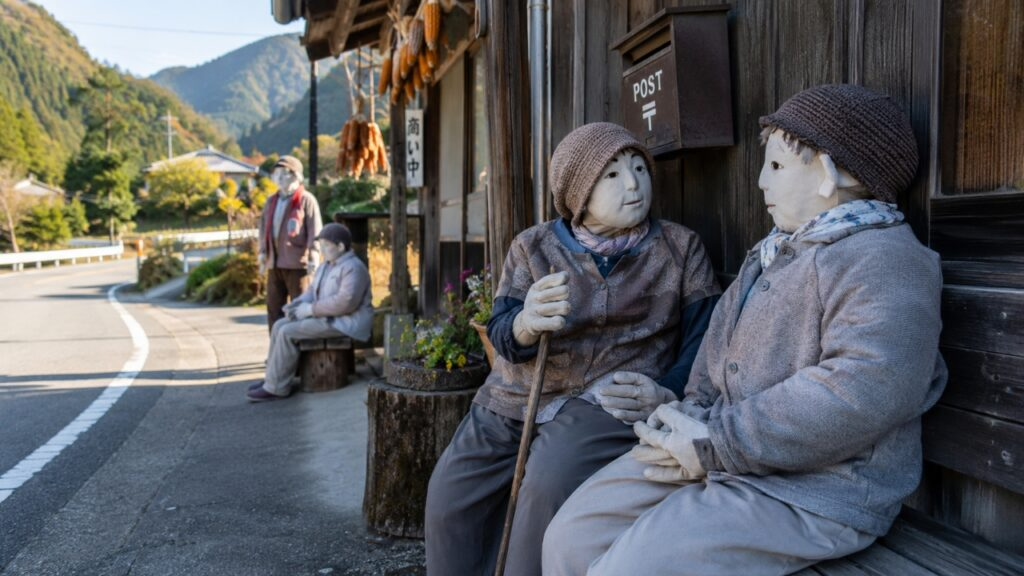
On a quiet mountainside in western Japan, a visitor might notice something unusual before hearing a single human voice. Elderly residents sit patiently outside their homes. Children wait at bus stops with backpacks resting neatly on their shoulders. Farmers pause beside fields, seemingly frozen in the middle of their work.

A closer look reveals an unexpected truth. None of them are alive.

The figures are life-sized dolls, carefully dressed in everyday clothing and placed throughout the village to represent people who once lived there. Some are positioned exactly where former residents spent much of their lives, creating scenes that appear remarkably ordinary—until they remain perfectly still.

The village is called Nagoro, located deep in the mountains of Japan’s Tokushima Prefecture. While much of the world associates Japan with crowded cities, high-speed trains, and neon-lit streets, places like Nagoro tell a very different story about the country’s changing demographics.

Over the past several decades, many younger Japanese have left rural communities in search of education and employment in larger cities. As opportunities became increasingly concentrated in urban centers, villages across the country began losing both their working-age population and their children. Schools closed. Businesses disappeared. Entire neighborhoods gradually fell silent.

Nagoro experienced the same transformation. As residents moved away or passed on, empty houses became increasingly common. Instead of watching familiar faces disappear without a trace, one local resident decided to preserve their memory in an unusual way.

Using fabric, straw, and simple materials, she began creating life-sized dolls modeled after former villagers. Some represented neighbors she had known for years. Others recreated relatives, teachers, or workers who had once formed part of the community’s daily life. Each doll was carefully dressed and placed in locations connected to the person it represented.

Today, the village is home to hundreds of these handmade figures—far outnumbering its remaining human residents.

The dolls are not intended to deceive visitors into believing the village is still full of people. Instead, they serve as quiet reminders of lives once woven into the community. A fisherman appears ready for another morning by the river. Students remain seated inside an abandoned classroom. A couple waits together at a bus stop that no longer receives many passengers.

For first-time visitors, the experience can feel strangely unsettling. The village appears occupied, yet remarkably still. Streets remain clean, gardens are maintained, and homes stand intact, but the movement and conversations that normally define a community have largely disappeared.

Nagoro has since become an unexpected destination for travelers interested in rural Japan. Visitors arrive not because the village offers famous landmarks or dramatic landscapes, but because it captures a reality affecting many communities across the country.

Japan has one of the world’s oldest populations, while birth rates have remained below replacement levels for years. At the same time, many rural regions continue to lose younger residents to major metropolitan areas such as Tokyo, Osaka, and Nagoya. The result is a growing number of communities where schools close due to a lack of students, public services become harder to maintain, and abandoned homes steadily increase.

Although Nagoro is among the most recognizable examples, it is not an isolated case. Across Japan, hundreds of municipalities face similar demographic pressures as populations age and decline. Local governments have experimented with financial incentives, housing assistance, childcare programs, and remote-work initiatives in an effort to attract new residents, with varying degrees of success.

The dolls of Nagoro have therefore come to represent more than a local art project. They have become a visual symbol of a demographic challenge that extends far beyond a single mountain village.

Visitors often arrive expecting something unusual. Many leave reflecting on something much larger: how communities change when generations move away, and what remains after the people who shaped a place are no longer there.

In Nagoro, the answer is found not in monuments or museums, but in hundreds of silent figures that continue to watch over the village, preserving fragments of everyday life that might otherwise have faded from memory.


TAGGED:JapanNagoro
Share This Article
Facebook Copy Link Print
Avatar photo
ByAyu Maharani
Ayu Maharani is a lifestyle writer who loves exploring topics related to everyday living, wellness, personal growth, relationships, travel, fashion, and modern lifestyle trends. She enjoys sharing practical ideas and inspiration that help readers create a more balanced, fulfilling, and enjoyable life. As a Lifestyle author, Ayu covers a wide range of subjects, from self-improvement and productivity to home living, health, beauty, and lifestyle trends that shape how people live today.
Next Article Tonlé Sap Lake The Asian Lake That Disappears Almost Every Year
Leave a Comment

Leave a Reply Cancel reply

Your email address will not be published. Required fields are marked *

Popular Today

Why Japan Has Entire Villages With More Dolls Than People

A remote village in Japan has more life-sized dolls than human residents.…

The Asian Lake That Disappears Almost Every Year

Every year, one of Southeast Asia's largest lakes undergoes an extraordinary transformation.…

The Indonesian Island Where Nobody Is Allowed to Stay After Sunset

As the last boats leave before sunset, one Indonesian island returns entirely…

The Photo You Just Took Doesn’t Actually Exist

Your smartphone probably didn't capture a single photo. Every time you press…

Roy Suryo and Doctor Tifa to Face Trial in Jokowi Diploma Defamation Case

Indonesian prosecutors have transferred the case against Roy Suryo and Doctor Tifa…

You Might Also Like

LifestyleFood

Why Some of the World’s Most Expensive Coffee Is Made From Animal Waste

By Ayu Maharani
Asia
  • Central Asia
  • East Asia
  • Middle East
  • South Asia
  • Southeast Asia
Business
  • Companies
  • Economy
  • Markets
  • Real Estate
  • Startups
Entertainment
  • Celebrities
  • Gaming
  • Movies
  • Music
  • Television
Lifestyle
  • Fashion
  • Food
  • Health
  • Relationships
  • Travel
News
  • Crime
  • Government
  • Politics
  • Society
  • World
Science
  • Energy
  • Environment
  • Health Science
  • Research
  • Space
Sports
  • Basketball
  • Esports
  • Football
  • Motorsport
  • Other Sports
Tech
  • AI
  • Cybersecurity
  • Gadgets
  • Internet
  • Software
INFRAME ASIA
  • About Us
  • Advertise With Us
  • Career
  • Privacy Policy
  • Terms of Use
  • FTC Disclosure
  • Disclaimer
  • Contact Us

Copyright 2026 by INFRAME ASIA by INFRAME MEDIA GROUP INDONESIA

Asia
  • Central Asia
  • East Asia
  • Middle East
  • South Asia
  • Southeast Asia
Business
  • Companies
  • Economy
  • Markets
  • Real Estate
  • Startups
Entertainment
  • Celebrities
  • Gaming
  • Movies
  • Music
  • Television
Lifestyle
  • Fashion
  • Food
  • Health
  • Relationships
  • Travel
News
  • Crime
  • Government
  • Politics
  • Society
  • World
Science
  • Energy
  • Environment
  • Health Science
  • Research
  • Space
Sports
  • Basketball
  • Esports
  • Football
  • Motorsport
  • Other Sports
Tech
  • AI
  • Cybersecurity
  • Gadgets
  • Internet
  • Software
INFRAME ASIA
  • About Us
  • Advertise With Us
  • Career
  • Privacy Policy
  • Terms of Use
  • FTC Disclosure
  • Disclaimer
  • Contact Us

Copyright 2026 by INFRAME ASIA by INFRAME MEDIA GROUP INDONESIA

inframe asia
Welcome Back!

Sign in to your account

Username or Email Address
Password

Lost your password?