
For most of the year, it looks like an ordinary lake.
Fishing boats drift across calm water. Children play along the shoreline. Farmers cultivate land nearby, following routines that have existed for generations. To a first-time visitor, there is little to suggest that the landscape is about to undergo one of Asia’s most remarkable seasonal transformations.
Then the rains arrive.
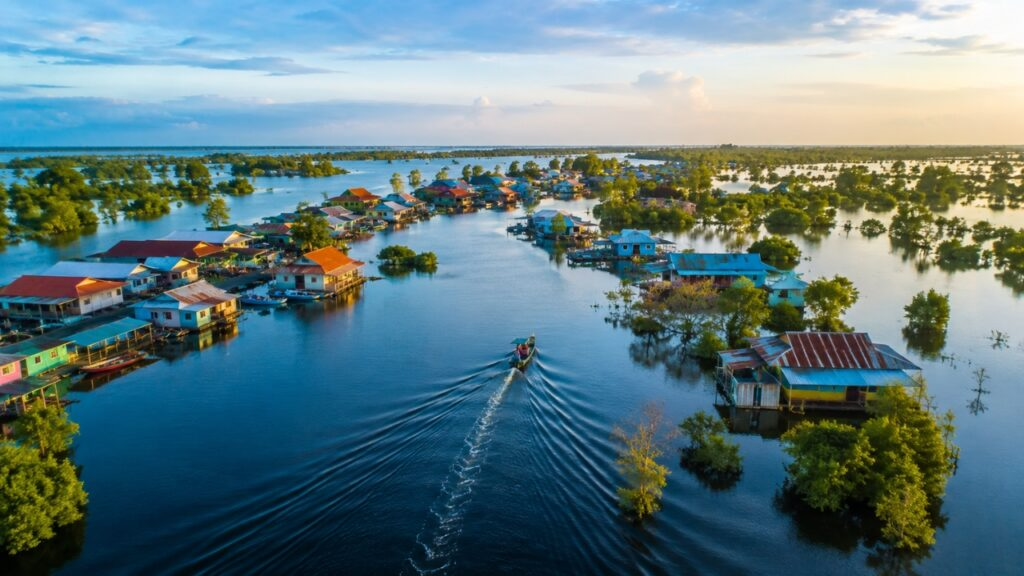
Within weeks, the lake expands dramatically, swallowing forests, roads, fields, and entire stretches of land that had been dry only months earlier. Villages that were once connected by dirt roads suddenly become accessible only by boat. Trees emerge from the water like islands, while floating homes replace vehicles as the primary means of transportation.
This is Tonlé Sap Lake, the largest freshwater lake in Southeast Asia and one of the few places on Earth where a river reverses its direction every year.
The transformation begins hundreds of kilometers away, in the mighty Mekong River. During the monsoon season, enormous volumes of water flow downstream toward the sea. The surge becomes so powerful that it pushes water back into the Tonlé Sap River, forcing the river to flow in the opposite direction from its normal course.
Instead of draining the lake, the river begins filling it.
The effect is extraordinary. Depending on seasonal rainfall, Tonlé Sap can expand several times its dry-season size. Areas that previously served as farmland disappear beneath the water, while flooded forests become essential breeding grounds for fish and other aquatic life.
For local communities, this annual change is not viewed as a disaster but as the foundation of daily life.
Thousands of families have adapted to the lake’s rhythms over generations. Many live in floating villages where homes, schools, shops, and even places of worship rise and fall with changing water levels. Buildings are designed to move or remain above the expanding lake, allowing communities to continue functioning despite dramatic environmental changes.
Fishing is at the heart of the local economy. As floodwaters spread through surrounding forests, fish gain access to nutrient-rich habitats that support reproduction and rapid growth. When the waters eventually recede, many species return to the main lake and river system, creating one of the world’s most productive inland fisheries.
Scientists regard this seasonal flooding as one of the most important ecological events in Southeast Asia. The lake supports hundreds of fish species and provides food and livelihoods for millions of people across Cambodia. Its unique hydrological cycle has also created wetlands that attract large populations of migratory birds and other wildlife.
Yet the system remains highly sensitive to change.
Climate variability, upstream dam construction, and shifting rainfall patterns have raised concerns among researchers about how future water flows could affect the lake’s annual expansion. Even relatively small changes in the timing or volume of seasonal flooding may influence fish populations, agriculture, biodiversity, and the communities that depend on them.
For visitors arriving during different times of the year, Tonlé Sap can appear almost like two entirely separate landscapes. A village photographed during the dry season may seem impossible to recognize months later when the same area lies beneath several meters of water. Roads become waterways. Forests become wetlands. Open fields become part of the lake itself.
It is a reminder that some of Asia’s most extraordinary destinations are not defined by permanent landmarks, but by landscapes that reinvent themselves every single year.